Electric Daisy Carnival
EDC Las Vegas
Three nights at a racetrack in the desert, and more people than any other electronic music festival. Where it happens, how big it really is, who owns it, and what plays away from kineticFIELD.
The biggest night out in the desert.
What is EDC Las Vegas, for people who have never been? A festival at a racetrack in the desert, three nights long, with carnival rides between the stages and more people through the gates than any other electronic music festival Wikipedia lists. In 2026, its 30th anniversary, six of its stages were also streamed live on Insomniac's YouTube channel.
This guide covers where it happens and when, how big it really is, how a party in a field in Chino, California became the flagship of a company, and why it became famous. Then the question this site is here for: past the fireworks over kineticFIELD, what does the Electric Daisy Carnival actually play? One thing first. EDC here is the festival, not everyday carry, the name for the knives and torches people keep in their pockets.
Where EDC Las Vegas happens.
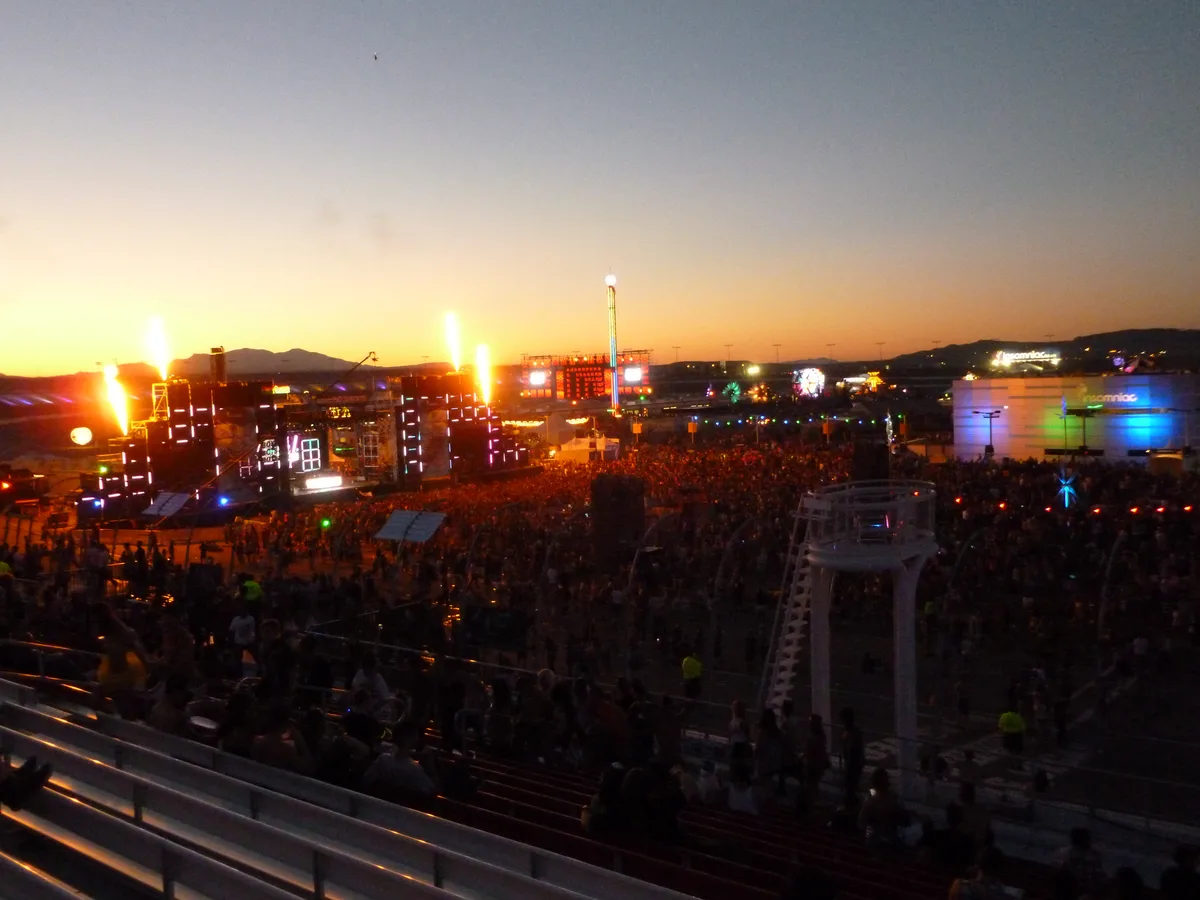
Where is EDC Las Vegas? At the Las Vegas Motor Speedway, a racetrack in Nevada, where the flagship has been held every year it has run since 2011. The EDC Las Vegas location is the result of a move. After the 2010 edition in Los Angeles, the city suspended the festival's remaining and future events there pending new safety rules, and in 2011 Insomniac took it to the speedway.
When is EDC Las Vegas? In May, over three nights, Friday to Sunday. Until 2017 it was held in June; in 2018 it moved to May so that it would run in cooler conditions, and the same year it added camping on site. Traditionally the Las Vegas edition runs dusk to dawn: the lineups begin in the late evening and end at sunrise.
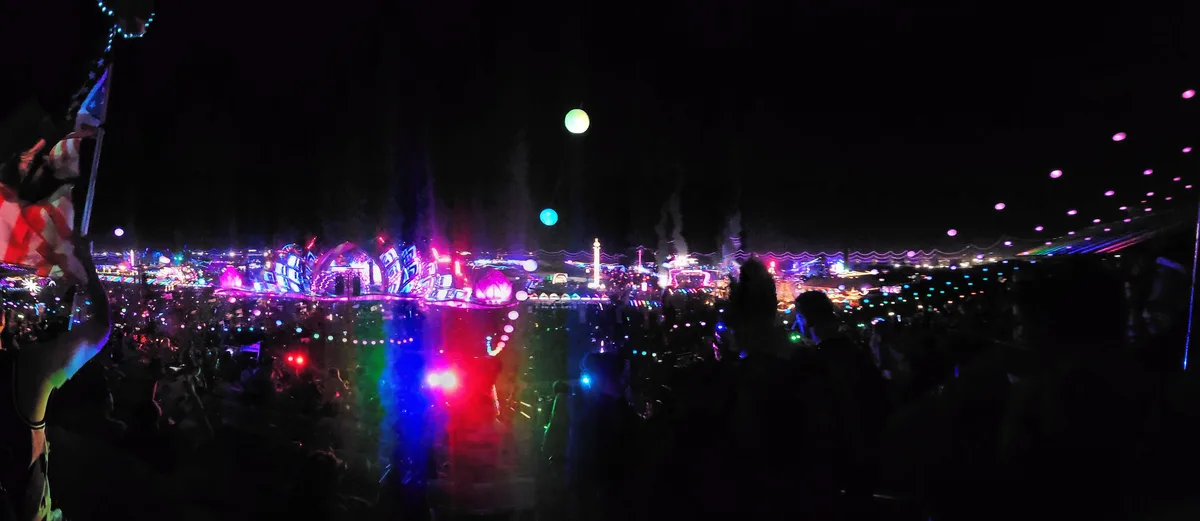
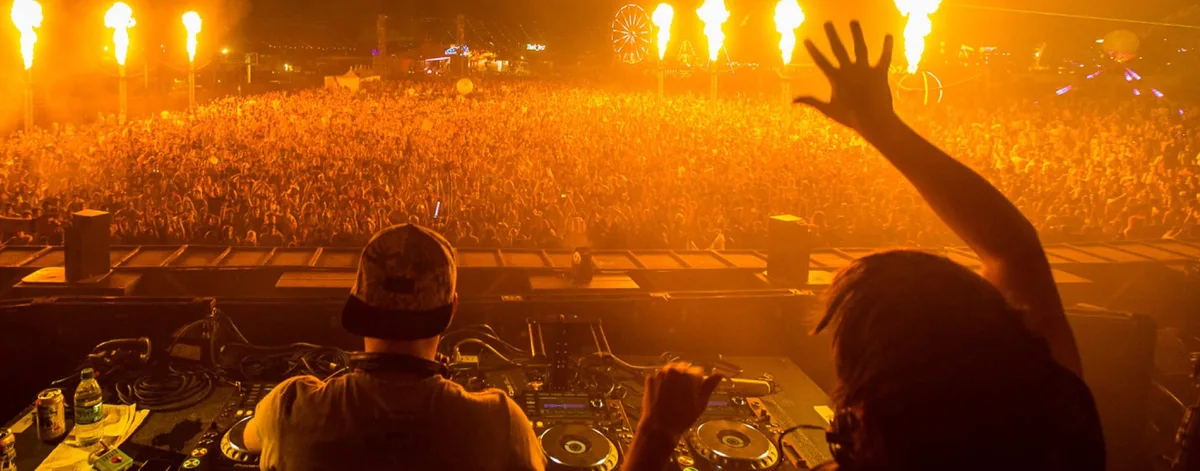
Inside the speedway, by Wikipedia's count, there are nine stages, roaming art cars, 18 carnival rides and four Ferris wheels, run by more than 5,000 staff. The largest stage, kineticFIELD, holds 70,000 people for a headliner. In 2026 DJ Mag counted 17 stages in all.
Las Vegas is the flagship, not the only EDC. As of 2026 the festival is held every year in Las Vegas and Orlando, with editions abroad in China, Colombia, Mexico, South Korea and Thailand.
EDC Orlando
Electric Daisy Carnival Orlando began in May 2011 at Tinker Field, on grounds next to the Florida Citrus Bowl, with about 12,000 people on the Friday and 20,000 on the Saturday. Later editions have mostly been held in November, and since 2019 it has run for three days instead of two.
EDC Mexico
EDC Mexico has been held since 2014 at the Autódromo Hermanos Rodríguez, a racetrack in Mexico City, usually in late February or early March.
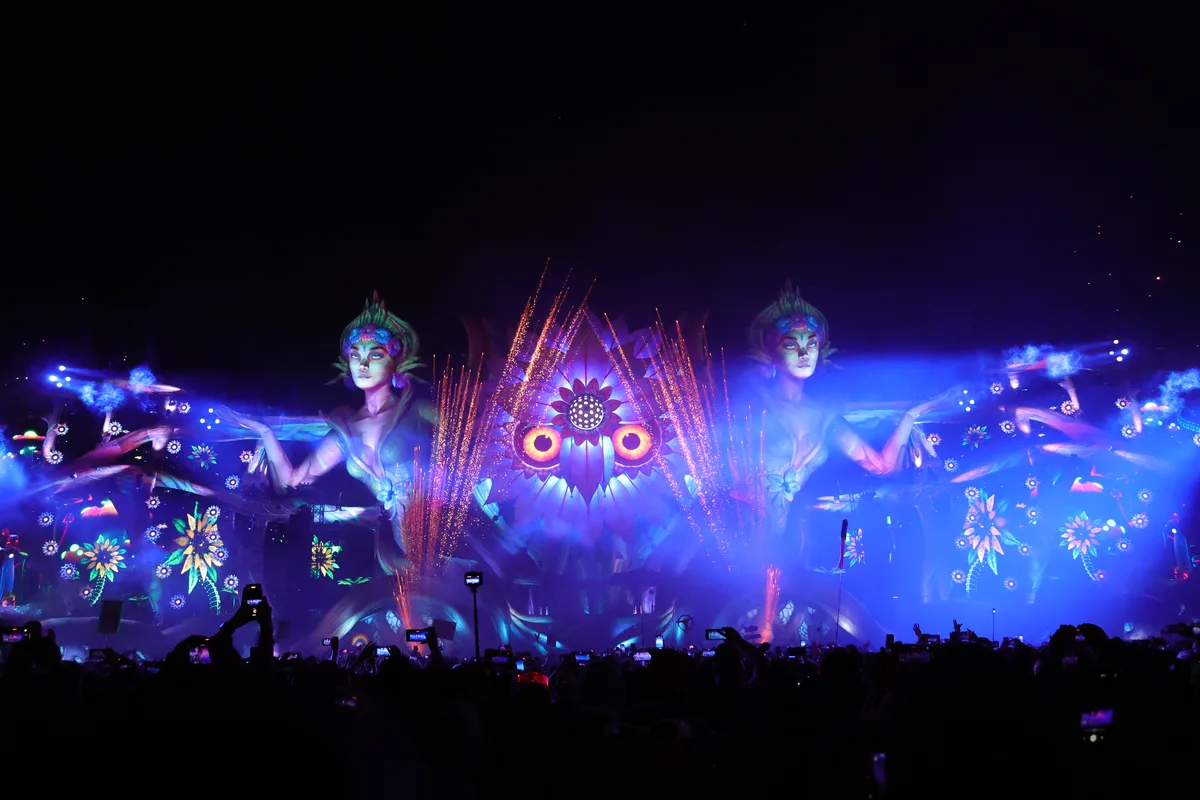
Mexico City has also been where new ideas are tried first. In 2022 EDC Mexico debuted Bionic Jungle, a house stage that reached Las Vegas later the same year.
EDC in the UK and elsewhere
EDC UK ran from 2013 to 2016, by its third year at the National Bowl in Milton Keynes; the 2017 edition was cancelled. Other editions have come and gone: Puerto Rico from 2009, São Paulo in 2015, New Delhi in 2016, Chiba in Japan in 2018 and 2019, Seoul Land in South Korea in 2019, and Phuket in Thailand from 2025. In 2023 Insomniac added EDSea, a festival cruise from Miami to the Bahamas.
How big EDC Las Vegas is.
How many people attend EDC? More than 500,000 over the three nights. The record is 525,000, set in 2023, and the 2026 edition, the 30th anniversary, sold out and welcomed more than 500,000 again. Wikipedia describes EDC Las Vegas as the largest electronic dance music festival worldwide.
A three-day total is not a crowd you see at once. Split evenly, 525,000 is about 175,000 a night. The daily figures that were reported in earlier years are lower: about 134,000 a day in 2014, and more than 135,000 on the opening night of 2017.
| Year | Attendance | Where, and what happened |
|---|---|---|
| 1991 | 3,500 | Chino, California: Stephen Hauptfuhr's first Electric Daisy Carnival |
| 2000 | 24,000 | Tulare, California; noise complaints ended the contract |
| 2010 | about 185,000 | Los Angeles Memorial Coliseum, two days |
| 2011 | 230,000 (reported) | First year at the Las Vegas Motor Speedway, three days |
| 2012 | 320,000 | |
| 2014 | 345,000 tickets | All sold before the gates opened |
| 2018 | about 411,400 | First year in May; camping added |
| 2019 | 465,000 | |
| 2020 | none | Cancelled for the pandemic |
| 2023 | 525,000 | The record |
| 2026 | more than 500,000 | 30th anniversary, sold out |
Growth came in steps, and each step had a venue behind it. The first Electric Daisy Carnival, in 1991, drew 3,500 people to a field in Chino. By 2010, at the Los Angeles Memorial Coliseum, it was about 185,000 over two days. The first year in Las Vegas, 2011, was reported at 230,000 over three.
The next step is a change of shape rather than size. From 2027 the flagship splits into two consecutive weekends, EDC Dusk and EDC Dawn, with identical lineups and a lower capacity each weekend. Rotella said the aim was "less congestion on the roads, in the skies, and at the hotels".
A short history, and who owns EDC.
Who owns EDC? The promoter Insomniac, founded by Pasquale Rotella. When did EDC start? Earlier than Insomniac's version of it.
Its roots are in 1986, when Stephen Hauptfuhr started throwing underground parties. In 1991 he organised the first Electric Daisy Carnival in Chino, California: an outdoor carnival that drew 3,500 people. He ran it again in 1992 and 1995. In 1995 the use of the name was granted to Rotella and Insomniac, in a deal made by his partner Philip Blaine, and Insomniac put on its first Electric Daisy Carnival in 1997, at the Shrine Expo Hall in Los Angeles.
For the next decade it moved around California: a waterpark in Newberry Springs in 1999; Tulare in 2000, where 24,000 people came and noise complaints ended the contract; then Hansen Dam in 2001, the first year with several stages, one of them the Bassrush Arena. From 2003 to 2006 it was at the NOS Events Center in San Bernardino, and from 2007 at the Los Angeles Memorial Coliseum. It became a two-day event in 2009.
2010 ended the Los Angeles years. About 185,000 people came. People under the required age of 16 got in, more than 100 were taken to hospital after a crowd stampede, and a 15-year-old, Sasha Rodriguez, died after taking MDMA. Los Angeles suspended the festival's future events pending new safety rules, and in 2011 Insomniac moved the flagship to Las Vegas and made it three days long.
In 2013 Insomniac signed a creative partnership with Live Nation that gave it access to Live Nation's resources. Rotella stressed that it was not an acquisition, and Insomniac kept creative control of its events. The festival that year was filmed for Under the Electric Sky, a documentary that premiered at the Sundance Film Festival in 2014.
The weather has shaped it too. In 2012 winds of up to 30 miles an hour closed the second night at 1 a.m., and 90,000 people were sent to the speedway's stands. In 2017 medical calls on the opening night doubled on the year before, much of it put down to heat, and in 2018 the festival moved from June to May. 2020 was cancelled for the pandemic, and 2021 ran in October. The 2026 edition was observed as EDC's 30th anniversary, and it ended with the announcement of the two-weekend format.
Why EDC got so famous.
Three things made EDC famous, and the first is the one in its name.
The carnival came before the festival. Hauptfuhr's first party in Chino was already an outdoor carnival, and the Las Vegas edition keeps the idea at scale: rides, Ferris wheels, carnival entertainers, art installations, and art cars that move through the crowd as small stages. Insomniac calls its audience Headliners.
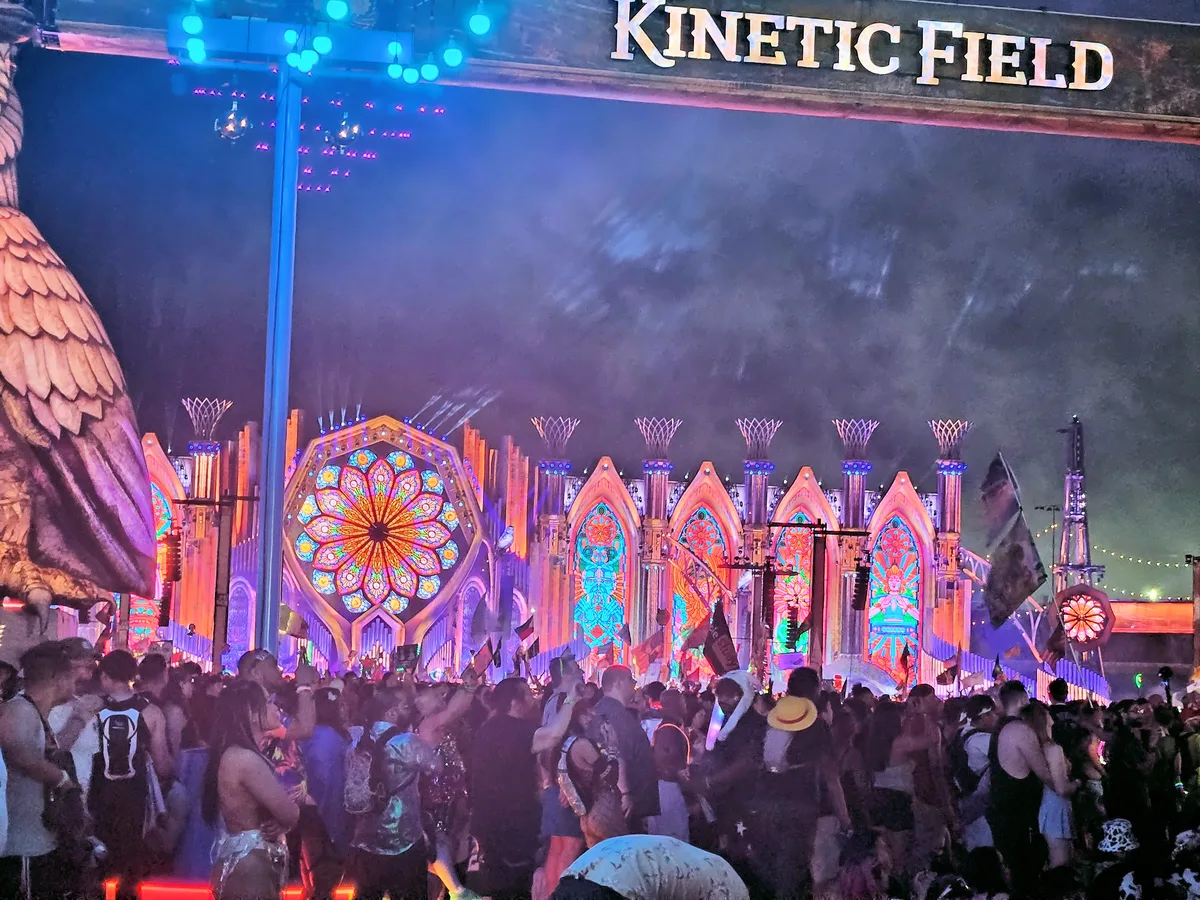
The second is the main stage. kineticFIELD is built to be looked at. In 2014 Insomniac set the record for the largest structural stage in North America, and one review of that year measured it at 440 feet wide and 80 feet tall, about 134 by 24 metres, with 1,000 lighting fixtures and 30 lasers.
The third is the hours. The Las Vegas edition has traditionally run from dusk to dawn, so each of its three nights ends at sunrise over the desert, and the festival is as much a Las Vegas week as a weekend. For 2027 Rotella said ticket prices would come down "closer to what they were a decade ago", partly to leave people money for the trip.
The music
What the music actually is.
EDC is not a genre festival, and kineticFIELD is not the whole of it. The main stage carries festival house and the biggest EDM names: Tiësto played it in 2024, and in 2026 the kineticFIELD lineup included Martin Garrix, Armin van Buuren, FISHER, John Summit and Charlotte de Witte.
Away from it, the EDC stages are sorted by sound more clearly than at most festivals of this size. neonGARDEN is house and techno, and in 2026 it carried Time Warp takeovers alongside Peggy Gou and Joseph Capriati. quantumVALLEY is trance. wasteLAND, hosted by Insomniac's hardstyle brand Basscon, is hardstyle. bassPOD, hosted by Bassrush, is drum and bass and dubstep.
Drum and bass is the part this site cares about most, and at EDC it goes back further than the main stage suggests. Bassrush is Insomniac's drum and bass and dubstep brand, and a Bassrush Arena was one of the stages the first time the festival split into several, at Hansen Dam in 2001. At bassPOD in 2014, in the furthest corner of the speedway, Camo & Krooked played in a run that also included Datsik, Destroid and 12th Planet.
Jungle has turned up too: in 2016 Mixmag's Lab at the festival filmed Rusko playing a jungle set. And in 2026 Sub Focus took drum and bass to kineticFIELD itself, the stage built for EDM's biggest names.
The 30th anniversary also booked the records this site's music grows from. The Prodigy played EDC Las Vegas for the first time, on cosmicMEADOW on the Saturday night, which HARD hosted, and Underworld were among that stage's headliners too.
For a listener who comes from breaks, jungle or drum and bass, that is the useful thing to know. EDC is worth the trip for the carnival and the scale, and the music worth crossing an ocean for is on bassPOD and cosmicMEADOW, not only under the fireworks at kineticFIELD.
Hearing EDC from home.
Insomniac streams EDC live on its YouTube channel, six stages at once in 2026, and posts full sets afterwards. The two below are among the festival's most watched, and both are on Stage Hoppers' list of its best sets: Above & Beyond on kineticFIELD in 2015, nearly five million views on the trio's own channel, and Alison Wonderland on kineticFIELD in 2016, more than two million on hers.
Insomniac also works with Tomorrowland: the two co-produce UNITY at Sphere in Las Vegas, which our Tomorrowland guide covers with the rest of that festival. Our guide to live DJ sets covers who else films the music. And the Selector plays one full DJ set at random from 62,877, among them the sets Mixmag filmed at EDC Las Vegas in 2016.
EDC Las Vegas FAQ.
Is EDC a rave or a festival?
A festival that grew out of the rave. It is a ticketed event at a racetrack with more than 500,000 people, and it began with Stephen Hauptfuhr, who had been throwing underground parties since 1986 before his first Electric Daisy Carnival in 1991. The Las Vegas edition still runs through the night until sunrise.
How many people attend EDC per day?
About 175,000 a night, if the 2023 record of 525,000 is split evenly over three days. Daily figures reported in earlier years were lower: about 134,000 a day in 2014.
How much do EDC Vegas tickets cost?
For 2027, when the festival runs over two weekends, a single-weekend general admission pass starts at $399.99, GA+ at $499.99 and VIP at $899.99, and a pass for both weekends starts at $599.99. In 2026 general admission started at $524.99.
When is EDC Las Vegas?
In May, Friday to Sunday, from dusk to dawn. It moved from June to May in 2018 for cooler weather, and from 2027 it runs over two consecutive weekends in May.
Why is it called EDC?
What does EDC stand for? Electric Daisy Carnival, the name Stephen Hauptfuhr gave his outdoor carnival party in Chino, California, in 1991. Insomniac has used the name since 1995, and the festival's own hashtag shortens the Las Vegas edition to EDCLV.
Is EDC the biggest festival in the US?
By attendance it is among the largest anywhere, with more than 500,000 people over three days, and Wikipedia describes EDC Las Vegas as the largest electronic dance music festival worldwide. Tomorrowland, for comparison, drew 400,000 over two weekends in 2026.
Sources.
- Wikipedia: Electric Daisy Carnival
- Wikipedia: Insomniac (promoter)
- Beatportal: EDC Las Vegas to Split Into Two Consecutive Weekends in 2027
- DJ Mag: EDC Las Vegas expands to 12 days and two full weekends in 2027
- DJ Mag: EDC Las Vegas 2026 full line-up announced
- DJ Mag: Here's how to stream EDC Las Vegas 2026 from home
- We Rave You: The Prodigy to play EDC Las Vegas for the first time ever
- RaverRafting: The Epic Stages of EDC Las Vegas 2014
- Discotech: Guide to EDC Las Vegas Stages
- My Modern Met: EDC 2026, Half a Million People Under One Electric Sky
- Bandwagon: Tomorrowland Belgium 2026 wraps with 400,000 fans
- Las Vegas Weekly: Insomniac and Tomorrowland go b2b for Unity at Sphere
- Mixmag on YouTube: Rusko (jungle set) in The Lab at EDC Las Vegas
- Stage Hoppers: EDC Las Vegas All Time Best Sets
Continue reading
Read next.
 A14Guide / Tomorrowland / ~9 min
Tomorrowland Festival: Where It Is, How Big, and the Music
A park in Boom, Belgium, that most of the world knows through a livestream: where Tomorrowland happens, how big it is, who owns it, and what plays off the Mainstage.
Read article → A16Guide / Creamfields / ~10 min
Creamfields Festival: Where It Is, How It Grew, the Music
Four days on the Daresbury estate every August bank holiday: where Creamfields happens, how a Liverpool house night grew into it, who owns it, and what plays beyond the Arc Stage.
Read article → A09List / Boiler Room / ~13 min
Best Boiler Room Sets of All Time, Ranked and Measured
Eighteen sets picked for what happens in them, beside the ten most-watched, counted across 8,206 Boiler Room recordings.
Read article → A10Guide / Burning Man / ~12 min
What Is Burning Man? The Event, the City and the Music
A city built in the Nevada desert for a week, with no lineup and nothing for sale, and the sound camps that play anyway.
Read article →