DJ gear
Technics 1200 vs 1210
Compare Technics SL-1200 and SL-1210 decks by generation, voltage and condition. Read the actual model badge before buying a used pair.
Read the model number before comparing prices
| Listing says | What to ask for |
|---|---|
| “SL-1200” or “SL-1210” | Full suffix and a photo of the model badge |
| “Black 1210” | Identification plate and photos of the actual deck |
| “Imported” or “European model” | Voltage and frequency on the electrical label |
| “Serviced” | A receipt with the date, parts and work done |
| “Matched pair” | Photos of both badges and a speed demonstration on both decks |
Older silver 1200s and dark 1210s explain why sellers still use a colour shorthand. A U.S. 1200MK7 in black is a factory option. On a used deck, paint or a swapped plinth can further confuse a listing. Read the badge and electrical label on the unit that will ship.
Ask for a clear photo of each deck’s model and serial label and one photo of the full deck. Panasonic’s North American MK7 manual places the identifying details on the back or underside. Sellers sometimes price a black deck by the name they recognise from its colour, then use stock images to fill in the listing. Keep the photos with the receipt so you can distinguish the units if one needs service. A serial number identifies the deck you inspected. Its digits alone say little about arm wear or whether the pitch fader is original.
Same-generation decks and mixed pairs
Technics publishes a joint operating manual for the SL-1200MK7 and SL-1210MK7 in several markets. The manual describes the same pitch ranges and basic controls. On those models, look at the price and condition of the actual units before paying extra for a particular badge.
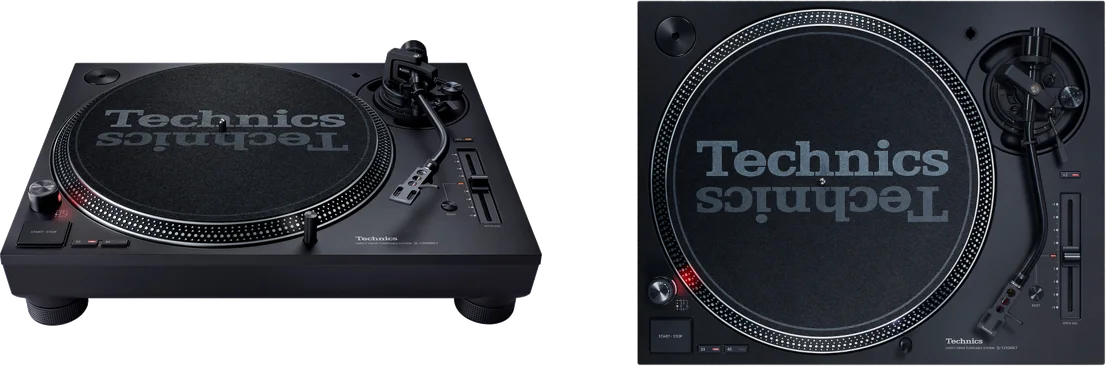
A 1200MK2 next to a 1210MK7 gives you a different pairing. On the older MK2, the pitch fader has a centre click at zero. The MK7 has a separate pitch reset control and two pitch ranges. If you intend to swap between decks mid-set, try the controls on the pair you plan to buy. See the SL-1200MK7 review for the new deck’s package contents and alternatives.
For example, a silver U.K. SL-1200MK7 and black U.K. SL-1210MK7 are a sensible same-generation pair if their individual labels and condition check out. They share the core MK7 pitch controls. The colour match is a matter of taste. You may still want matching cartridges and the same pitch-range setting before practising on both.
A 1200MK2 and 1210MK7 can also mix together. Expect the pitch controls to feel different and ask yourself whether that matters for a permanent pair. If a seller is asking matched-pair money for two decks with different generations, price each one on its own contents and condition first.
Check the voltage on the actual deck
The North American owner’s manual lists 120 V at 60 Hz for the SL-1200MK7. The U.K. manual for both MK7s lists 110 to 240 V AC at 50 or 60 Hz. Panasonic supplies separate North American and international manuals. If the seller is importing a turntable or using stock pictures, ask for a photograph of its own ratings. A plug adaptor changes the plug shape. Use the supply the deck is rated for.
A listing headed “UK 1210” with a different plug deserves a second photo before payment. Identify the deck on the ratings label, then compare the printed voltage and frequency with the supply where it will be used. A U.S. MK7 with a 120 V, 60 Hz label should be judged by that label even if you can buy an identically styled deck locally. If the marking is missing or illegible, ask Technics or a qualified service shop to identify that unit before you buy it.
| What the seller sends | What to read |
|---|---|
| The model badge | Match the full SL-1200 or SL-1210 suffix to the maker’s manual. |
| The voltage label | Check both voltage and frequency for the country where you will run it. |
| Two separate deck photos | Read the label on each deck before treating the pair as identical. |
Inspect a used pair before you buy
Ask the seller to play a record on both decks and check for hum or a missing channel. Watch the platter at its usual speeds and ask them to move the pitch fader through the middle of its travel. Look at the arm bearings, feet and output cables. On an older unit, a speed or tonearm repair can erase a small saving on the asking price. A mixed-colour pair can be a good buy when both decks pass the same checks.
For a local collection, let each deck play long enough to hear both outputs, then ask to hear the second deck through the same known mixer input and cartridge if practical. That helps isolate a fault in the setup from a fault in the deck. Watch the strobe dots at the reference speed and check the pitch moves in both directions. With the power off and the stylus protected, look for obvious damage or excessive play at the arm rather than forcing it around. Confirm what comes with the deal: headshell, cartridge, ground lead, mat, dust cover and any transport packaging.
For a shipped deck, ask what the seller will remove and pack separately. Panasonic’s MK7 manual removes the headshell, platter and balance weight before transport. Damage risk enters the price comparison if you have to depend on a seller’s packing or buy several missing pieces on arrival.
FAQ
Can I use a 1200 and 1210 together?
Yes, if each deck works with your mains supply and your mixer has appropriate phono inputs. A same-generation pair is the simplest place to start if you want the same controls on both sides.
Does a black Technics always mean SL-1210?
Technics lists a black SL-1200MK7 in the U.S. Read the model badge to distinguish it from a black SL-1210MK7.
Is the Technics SL-1210MKX the same as an SL-1210MK7?
The MKX is a separate club and touring model. Its heavier chassis, different feet and expanded pitch settings belong to that model, so check the full suffix on used and new listings.
Sources.
Continue reading
Read next.
 Crate digging~5 min read
Best Turntable Cartridges for Listening and DJing
Choose a cartridge for your turntable by mount, phono stage, stylus and playing style. Compare home-listening options with back-cueing picks.
 Crate digging~5 min read
Best Turntable Styluses and DJ Needles
Match the stylus to the cartridge you own. Compare direct replacements, compatible upgrades, DJ needles and a tip for suitable shellac records.
 Crate digging~5 min read
Best Audio-Technica Turntables for Listening and DJing
Compare five Audio-Technica turntables by playback controls, cartridge, USB and phono output. Find the right model for your speakers or DJ mixer.
 Crate digging~5 min read
Technics SL-1200MK7 Review for Vinyl DJs
See what the SL-1200MK7 does well, what is in the box and what two working decks cost beside Reloop and Audio-Technica alternatives.